
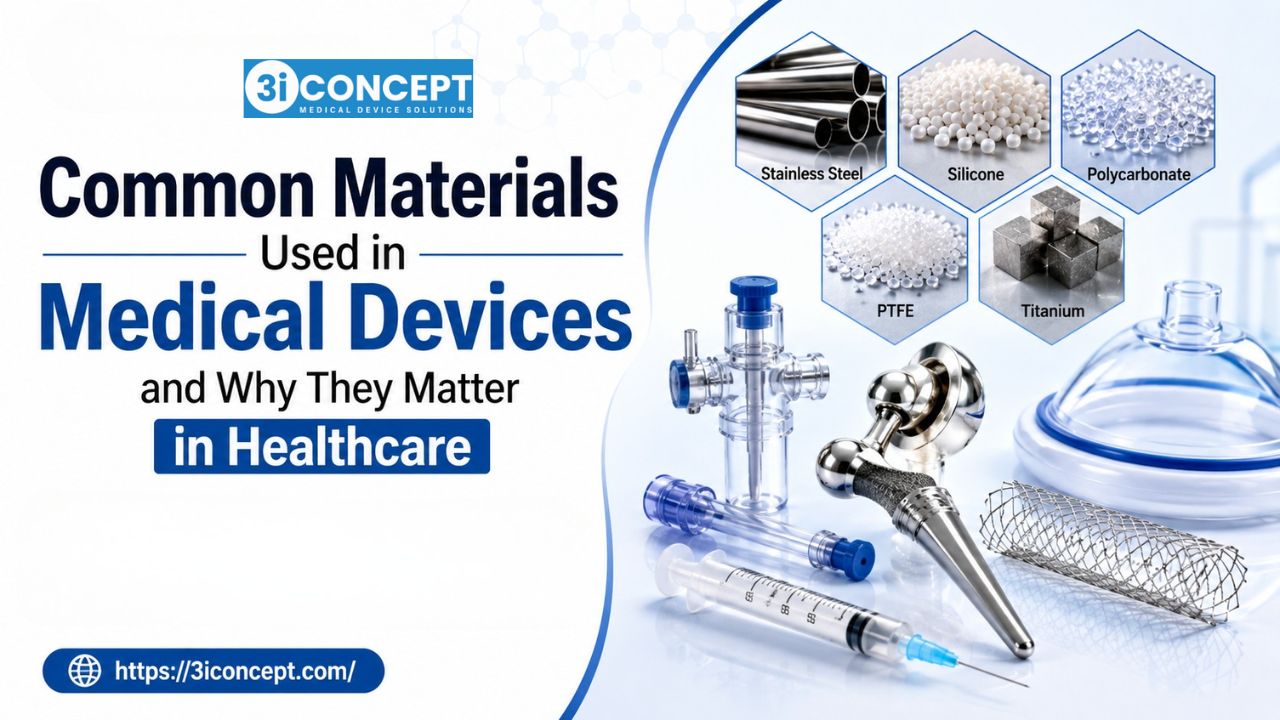
Most people never think twice about the syringe used during a blood test or the catheter placed before surgery. But behind every one of those devices is a very deliberate decision about what it is actually made from. The materials used in medical devices don’t just give a product its physical form, they determine whether it will be safe inside or alongside the human body, sometimes for years.
Pick the wrong material and the consequences are serious: an immune response, a device that cracks under pressure, chemicals leaching into the bloodstream. Pick the right one, and the device quietly does its job without the patient even noticing it’s there.
Across the UK and Europe, material selection sits at the heart of regulatory approval. The EU MDR 2017/745 and ISO 10993 biocompatibility standards exist precisely because this decision matters so much. This guide breaks down the main material groups used across medical devices today, why they’re chosen, and what manufacturers need to know before committing to them.
Why Material Selection Is the Foundation of Medical Device Safety?
A device material does far more than determine its physical shape. It defines how that device interacts with the human body over time. Poor or unsuitable choices can lead to:
- Localised inflammation or allergic reactions at the contact or implant site
- Premature device degradation and mechanical failure
- Leaching of harmful chemicals into surrounding tissue or fluids
- Non-compliance with EU MDR and UKCA marking requirements
Regulatory bodies including the MHRA (UK), the European Commission, and notified body opinion under EU MDR all require comprehensive biological evaluation and material traceability as core conditions of market authorisation. There are no shortcuts.
Key Material Categories Used Across Medical Devices
1. Metals and Metal Alloys
Metals have been used in medical devices for well over a century, and for good reason. They are strong, predictable, and when specified correctly, they last. Stainless steel (316L grade) is still the backbone of most surgical instruments, needles, and bone fixation hardware — it resists corrosion, tolerates sterilisation cycles, and is cost-effective to manufacture.
For load-bearing implants, titanium and its alloy Ti-6Al-4V have become the materials of choice. Surgeons and engineers trust it because bone actually grows around it rather than rejecting it — a property known as osseointegration. Cobalt-chromium alloys serve similar roles in hip and knee replacements, where wear resistance over millions of cycles is non-negotiable.
Then there is Nitinol — a nickel-titanium alloy with a behavior that still feels somewhat counterintuitive until you have seen it in action. It has a shape memory, meaning it can be compressed for delivery through a catheter, then expanded to its preset form once positioned. That property makes it ideal for self-expanding stents and guidewires.
Under EN ISO 10993-1, all metallic implants used in the UK and EU must complete a formal biological evaluation before CE or UKCA marking is granted. Ion release studies and corrosion testing are typically part of that package.
2. Medical-Grade Polymers and Plastics
Walk into any clinical setting and you are surrounded by polymers — the IV line running into a patient’s arm, the syringe on the tray, the transparent cassette housing a diagnostic strip. Polymers account for the vast majority of disposable and single-use device components, and their popularity comes down to one thing: versatility.
Polypropylene (PP) is everywhere. It is lightweight, chemically resistant, and takes well to sterilisation, which is why it ends up in syringe barrels, blood collection tubes, and IV set components. DEHP-free PVC has largely replaced conventional PVC in blood bags and fluid lines following EU restrictions on phthalate plasticisers. Polyurethane and PTFE (Teflon) are the go-to choices for flexible catheters and vascular grafts, valued for their smooth surfaces and low friction.
At the higher end of the performance spectrum sits PEEK – Polyether Ether Ketone. It is expensive and demanding to process, but for spinal implants and orthopaedic hardware that need to be both radiolucent and mechanically tough, there is not much that competes with it.
The shift toward DEHP-free formulations reflects a broader regulatory trend in Europe. EU MDR now requires a formal risk-benefit justification for any substance of concern found in patient-contacting materials, which has pushed manufacturers to audit their polymer supply chains carefully.
3. Silicone
Silicone has a quality that makes it difficult to replace in many applications: the body tends to tolerate it well. It is flexible enough to move with soft tissue, stable enough to last inside the body for years, and inert enough that it does not react with most biological fluids or drugs.
Foley catheters, drainage tubes, feeding tubes, and neonatal care devices all commonly use medical-grade silicone. In reconstructive surgery, silicone forms the shell of tissue expanders. In device manufacturing, it appears as seals and gaskets in assemblies where flexibility and a reliable seal are both required.
- Chemical characterisation with extractables and leachables profiling
- Sterilisation compatibility and residuals validation
UK manufacturers face an additional layer of complexity post-Brexit. UKCA marking for the Great Britain market now runs independently of CE medical device certification, with its own technical documentation requirements, conformity assessment routes, and MHRA registration obligations. For companies selling into both the EU and UK simultaneously, building a dual-pathway compliance strategy from day one saves significant time and cost later.
4. Ceramics and Bioactive Glass
Ceramics do not get as much mainstream attention as metals or polymers, but in orthopaedics and dentistry they are increasingly important. Alumina and zirconia ceramics are used in femoral heads for total hip replacements; they wear exceptionally well over time and produce fewer particulate debris than metal-on-metal alternatives, which has been a significant concern in long-term implant performance.
Hydroxyapatite deserves a mention specifically because of its relationship with bone. It is chemically similar to the mineral component of natural bone, which means when it is used as a coating on an implant or as a bone graft substitute, the body tends to integrate with it rather than wall it off. That biological responsiveness is genuinely useful in orthopaedic reconstruction.
Borosilicate glass sits at the more familiar end of the ceramics family, it is the material behind pharmaceutical vials, ampoules, and diagnostic containers. Under EU MDR Annex I General Safety and Performance Requirements, all ceramic-based implantable devices must demonstrate both mechanical and biological stability through structured clinical and pre-clinical evidence.
5. Biologically Derived and Natural Materials
Some of the most complex regulatory conversations in medical devices centre on materials that come from biological sources. Collagen wound dressings, cellulose-based sutures, and decellularised animal tissue valves all sit in this category — and they all attract a level of regulatory scrutiny that synthetic materials do not.
The concern is not that these materials do not work. Many of them work very well. The issue is traceability, processing consistency, and the risk of transmissible agents surviving the manufacturing process. EU MDR Annex I specifically addresses animal-derived materials and requires a TSE (Transmissible Spongiform Encephalopathy) risk evaluation alongside the standard ISO 10993 biological safety assessment. Manufacturers working with these materials need robust supplier qualification and batch-level documentation to satisfy notified body review.
Material Testing and Regulatory Compliance Across Europe
Selecting the right materials used in medical devices is only the starting point. Rigorous, structured testing is what converts good material choices into verified, patient-safe products. Under EU MDR and the ISO 10993 series, manufacturers must conduct a full biological evaluation programme that typically includes:
- Cytotoxicity assessment – does the material cause cellular harm in contact conditions?
- Sensitisation and irritation testing – does it provoke immune or allergic responses?
- Genotoxicity and carcinogenicity evaluation – particularly for implantable and long-contact devices
- Chemical characterisation with extractables and leachables analysis
- Sterilisation compatibility and residuals testing
For UK manufacturers, post-Brexit UKCA marking now operates independently of CE marking. While technical requirements remain broadly aligned with EU MDR, separate technical documentation, conformity assessment routes, and MHRA registration are required. Companies targeting both markets simultaneously need a clear dual-pathway compliance strategy from early development.
How Specialist Support Strengthens Your Compliance Position?
Navigating the intersection of material science, ISO 10993 biological evaluation, EU MDR technical file requirements, and UKCA obligations is genuinely demanding – particularly for manufacturers entering the European market for the first time or scaling an existing portfolio. 3iconcept Medical Device Solution provides specialist support across the full device development journey, from early material selection and biological evaluation strategy through to technical file preparation and regulatory submission – helping manufacturers build devices that satisfy clinical demands and clear every regulatory checkpoint.
Conclusion
Material selection is not a peripheral concern in medical device development – it is the technical and regulatory foundation upon which everything else is built. From stainless steel surgical instruments to advanced bioceramics and biopolymer composites, the full spectrum of materials used in medical devices reflects decades of clinical experience, materials science advancement, and hard-won regulatory learning.
For European manufacturers, demonstrating that the right materials have been chosen and rigorously tested – is central to achieving CE and UKCA marking and sustaining market presence. The path from initial material selection to patient-safe, market-approved product is a structured, evidence-based journey. The earlier that journey is planned with expert guidance, the smoother it tends to be.
Frequently Asked Questions
Simply put, it means the material won’t harm the body it’s touching. Every device that contacts tissue, blood, or bone must be evaluated under ISO 10993-1 to confirm it’s safe for that specific use.
Yes, things like DEHP, phthalates, and endocrine-disrupting chemicals are flagged under EU MDR 2017/745. If your device contains any restricted substance, you’ll need to justify why the benefit outweighs the risk in your technical documentation.
For a simple Class I device, typically 3–6 months. For a Class III implantable using novel materials, you could be looking at 12–24 months — so build this into your project timeline early.
They follow similar technical standards, but since Brexit they’re completely separate processes, different documentation, different notified bodies, different registrations. If you’re selling in both the EU and UK, you’ll need to satisfy both independently.
Not quite. ISO 10993-1 ties evaluation to the specific end-use — contact type, duration, patient group. A material cleared for one device may still need fresh assessment before it qualifies for a different application.
Have a Question?
Fill out the form and we’ll get back to you.